

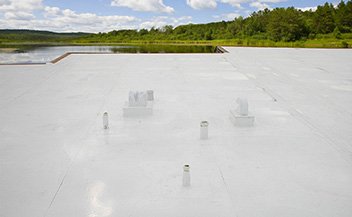
EPDM (ethylene propylene diene monomer (M-class) rubber) has properties that give it outstanding heat, ozone and weather resistance. One of its benefits it that is does not pollute the run-off rainwater. When EPDM is installed correctly as a covering to waterproof roofs,...
Hail Damage to a Flat Roof
Hail can cause damage to the underlying insulation of a flat roof causing lessened R-value. The damage is not usually noticeable when you just look at the membrane surface of the roof, but it will cause the insulation to “shattered”...
Slipping: Delaminating / Sliding
This Torch Down Modified roof membrane is delaminating and sliding. This is caused by improper fastening. On roofs with a slight pitch it’s required to fasten each row. Without lifting up every row and breaking the sealing asphalt seams, it’s...
Torn/Cracked/Broken Surface
As a roof expands and contracts the roof system moves. This is a daily occurrence and is associated with Thermal Shock. During movement the membrane binds against each other. Sometimes a tree branch or flying debris may impact the roof...
Offset Not Correct
The way membrane roofs work is by their overlapping design. As the previous layer is covered by the next it creates stair step water shed design, disallowing seepage and water backslaps. This stair step design also has a vertical component...
Ponding Water
A code violation and warranty exclusion on all asphalt based roof systems, ponding water is when water sits on a roof for more than 48 hours without being evaporated or running off naturally. Water ponding breaks down asphalt, which is...
Improper Number of Fasteners
Modified membranes are designed to be installed over an approved surfacing fastened to specific guidelines. If modified membranes are installed over a surface without the proper fastening the manufacturer’s warranty is voided and the roof assembly is out of code....
Improper Fastener Installation
It is important that all fasteners are installed perpendicular to the roof’s surface and driven in at a perfect 90-degree angle. On a Fort Myers roof I found areas where the fasteners were not driven straight in and the fastener...
Improper Fastener Type
When two different types of metals come in contact a chemical reaction occurs: Electrolysis uses moisture as catalysis at a molecular level to pass ions from one metal to the other. The process causes a deterioration of both metals similar...
Fasteners Uplifting
“High nails” were found on this Immokalee roof. During roof underlayment installation it’s easy for installers to forget about proper pressure setting on their nail guns. In most cases too many nailers are hooked up to a low volume compressor...
No Starter Strip
Membrane Starter strip is a narrow strip of membrane at the perimeter designed to seal perimeter flashings and prevent wind uplift. When membrane starter strip is omitted or not installed correctly strong winds have an opportunity to lift the first...
Flat Tie-In not Sealed Properly
The junction between your pitch roof and the flat roof is called the “tie-in”. This area is specifically important because there are two different roofing materials joining. This Fort Myers Beach roof shows evidence that the tie-in area is not...
Backwater Laps
When installing a roof system it is important to always start at the lowest point and proceed upward toward the roof’s peak. This ensures that each layer of materials overlaps the previous. Even on flat roofs, this principle is important....
Flashing Rusting
Steel metal flashings exposed to the elements can rust over time. Today’s flashings are made of galvanized metal, a process that protects the steel core from rusting. Rust cannot be simply sealed over, as it will continue to grow as...
No Sealant at Flashings
Although flashings bridge transitions in the roof, when not sealed properly they are ineffective. Flashing is designed to turn corners and breaks in a roof, which tend to have more movement than other areas. If not sealed properly, these flashings...
Valley Metal Buckling
Valley metal is installed by crimping the valley center, fastening the entire length of both edges and then applying mastic to cover the valley metal edge and fasteners. When valley metal is not properly pressed, fastened and/or sealed it causes...
Gable End Flashing Not Correct
Steel metal flashings exposed to the elements can rust over time. Today’s flashings are made of galvanized metal, a process that protects the steel core from rusting. An example of rusted flashings was found on this Marcos Island roof. Rust...
Boot Lapped/Sealed Correctly
As with all rooftop objects it is important that proper water flow and installation are considered. Flashing that is not layered correctly and sealant applied in the right junction areas allow water seepage. The boot flange was not installed correctly...
Vent not Lapped/Sealed Correctly
Valley metal is installed by crimping the valley center, fastening the entire length of both edges and then applying mastic to cover the valley metal edge and fasteners. When valley metal is not properly pressed, fastened and/or sealed it causes...
Plastic Boots Used
As you know, plastic typically dries out rather quickly in our environment. The sun’s UV rays cause oil migration much the same as it does to exposed asphalt. On this Naples roof a plastic stack flashing was used to seal...
Ell Flashing not Sealed Properly
Ell flashing bridges the transition from the roof’s surface and a wall or upright surface such as a curb. On this Bonita Springs roof the ell flashing has not been sealed properly and the shingles are pealing back from the...
No Ell Flashing Installed
Whenever a roof surface meets a vertical surface ell flashing is needed to bridge the transition and protect from seepage. Although sealant may have helped avoid leaks, over time sealant breaks down. The correct technique is to install ell flashing...
Ell Flashing Uplifting
Ell flashing should be nailed every six inches on center. Not enough fasteners were used and the sealant has deteriorated. I suggest sealing the underside of the ell flashing and installing the correct number of fasteners as specified by code....
Ell Flashing Behind Wall Surface
Ell flashing is designed to bridge the roof to wall transition and allow for protection against water intrusion. Water which runs down the roof and wall is caught by the ell flashing and channeled to the roof’s edge. It is...
Flashing Seams Separating
Flashing seams must be overlapped correctly and an adequate amount of sealant placed in between the overlap area to ensure proper waterproofing at the ell flashing transition area. Here we found ell flashing seams were separating and in need of...
No Wall Cap/Coupling
Separation firewalls are designed to extend past the roof level and protect against spreading flames in the unlikely event of a fire. Many times these walls are simply stuccoed and painted. Over time the paint deteriorates, often at rates faster...
Pitch Transition not Flashed
Whenever two different roof pitches transition a specially designed flashing is needed to bridge the slope change. This Fort Myers Beach roof does not have the correct flashing and is relying on sealant to disallow seepage. Over time the sealant...
Counter Flashing Loose
Counter flashing is metal flashing installed into the wall to protect the roof membrane from coming loose from the wall as it transitions from the roof area. Counter flashing can also be used in conjunction with ell flashing at the...
Fair/Unfair Metals Touching
When two different types of metals, fair and unfair as they are called, come in contact a chemical reaction occurs. Electrolysis uses moisture as catalysis at a molecular level to pass ions from one metal to the other. The process...
Pan Roof Tie-In Not Correct
Aluminum structures are inexpensive and easy to install. They often add value to a building by providing additional usable space. The roofing system is typically a pan or super-pan type made of aluminum and coated white. Insulation is sometimes used...
Granules Loss
Asphalt does not hold up to direct UV exposure. Modified membrane use small white colored stone chips called granules to protect the asphalt from environmental elements and to provide an esthetically pleasing look. Over time these granules wear off. When...
Fiberglass Intermat Showing
Modified membrane construction starts with a fiberglass intermat. During production the fiberglass intermat is saturated with asphalt and dried repeatedly until the desired thickness is achieved. This intermat is not a waterproofing layer but is necessary to keep the membrane...
Flat: Sprayed Polyurethane Foam
Sprayed Polyurethane Foam (SPF) roofs are new to the lineup and are designed primarily as an insulator, not a waterproofing roof system. The top applied coating is the true waterproofing agent and must be recoated yearly to keep the system’s...
Torn/Cracked/Broken Surface
As a roof expands and contracts the roof system moves. This is a daily occurrence and is associated with Thermal Shock. During movement the SPF binds against each other. Sometimes a tree branch or flying debris may impact the roof...
Roof Recovered Offset Not Correct
SPF Foam is not a waterproofing material. When installed correctly, with a heavy waterproof coating and a slight pitch, it does “shed” water. However, SPF foam has millions of small holes called air pockets created at the time of installation....
Improper Number of Fasteners
SPF roofs are designed to be installed over an approved surfacing fastened to specific guidelines. If SPF roof is installed over a surface without the proper fastening the manufacturer’s warranty is voided and the roof assembly is out of code....
Information About: Tar & Gravel
Tar & Gravel roofs have been around for centuries. Constructed by layering asphalt and felt then finishing the system with a heavy coat of asphalt and gravel, these systems are used primarily on large commercial flat roof area. Tar &...
Torn/Cracked/Broken Surface
As a roof expands and contracts the roof system moves. This is a daily occurrence and is associated with Thermal Shock. During movement the membrane binds against each other. Sometimes a tree branch or flying debris may impact the roof...
Fiberglass Intermat Showing
Tar & Gravel roof construction starts with layers of fiberglass felt paper and asphalt. This intermat is not a waterproofing layer until it is layered with asphalt and more fiberglasses felt paper. Over time the membrane surface wears down. Eventually...
Flat Roof Repair
Van Martin Roofing of Dayton, Ohio can repair your flat roof and make it stop leaking.


